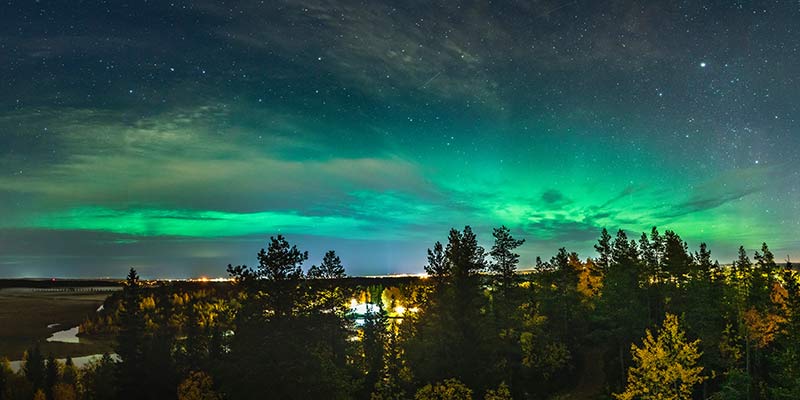
Can you see the Northern Lights in California? Learn when, where, and how to catch this rare celestial show in the Golden State.
When people think of the Northern Lights, the first locations that come to mind are Iceland, Alaska, Norway, and Canada. Very few people ever think about California. But despite its location far below the auroral oval, when the conditions are just right, the aurora borealis is actually visible in the Golden State.
Can You See the Northern Lights in California?
It’s important to remember that the visibility of the Northern Lights in California is extremely rare. Due to its location farther south of the auroral oval, it takes a very strong geomagnetic storm to make the skies shine bright. However, even when the conditions are just right, you’ll need to head all the way to the northernmost part of the state.
When we talk about conditions, we’re referring to solar activity. And when determining whether or not you can see the Northern Lights in California, we need to look at solar flares, coronal mass ejections, and the geomagnetic storms they create on Earth. In order to see the elusive lights in the northernmost part of the state, you’ll need a KP index of at least 7.

Historical Aurora Sightings in California
Despite its location, California has actually experienced a few notable auroral displays in recent years. Although rare, during the peak of the solar cycle, the chances of capturing a glimpse of them increase significantly.
One of the more recent and widely reported sightings of the Northern Lights occurred in May 2024. During this month, there was a powerful G4-level magnetic storm that lit up the night skies all the way down to Central California. There are photos of the aurora over Mount Shasta, Redding, and even along the northernmost borders of the San Francisco Bay Area.
During the previous solar cycle, an event occurred in October 2003 that became known as the Great Halloween Storm. These were a series of intense geomagnetic storms that allowed auroras to be seen as far south as the Central Valley.
However, the most notable and historic sighting of the Northern Lights in California occurred back in February 1958. There was a powerful solar storm that winter which lit up the night sky with red auroras as far south as Los Angeles and San Diego. Dubbed the “Storm for the People,” this extremely powerful geomagnetic storm took place on February 10, 1958, between 9 and 10 PM.
Where Can You See the Northern Lights in California
As always, when it comes can you see the Northern Lights in California, location is everything. As one of the most populous states in the union, you’ll need to head to a location far away from any bright lights. Extremely dark skies are necessary, and high altitudes can help reduce obstructions. As a result, when hunting for the aurora in Northern California, the best place to be is Mount Shasta.
With its towering peak and extremely remote surroundings, Mount Shasta is one of the state’s most promising viewing locations. It is surrounded on all sides by national forests and wilderness areas that provide dark skies and minimal light pollution. This creates ideal conditions for viewing an aurora event.
Another popular spot for viewing the elusive lights is Lassen Volcanic National Park. This relatively isolated region in northern California offers visitors clear, dark skies as well as expansive views. It’s a popular destination for stargazers.
You also have destinations along the Sierras, including Mammoth Lakes and Bishop. Both remote towns—although located farther south—are elevated high in the mountains and offer wide-open skies. When solar activity is especially intense, there’s a good possibility of being able to view the aurora from the slopes.
Remember, more than 10% of the entire U.S. population lives in California. As a result, there are more urbanized areas than in any other state. Because of this, there is generally too much light pollution to view the Northern Lights, even during major solar events. Nevertheless, when the KP index is high enough, heading up to the Santa Cruz Mountains or Marin Headlands can provide you with decent viewing opportunities.

How to Prepare for an Aurora Sighting
If you’re planning on hunting for the elusive lights in California, you’ll need to prepare. The two most important factors in viewing the Northern Lights in California are patience and luck. The displays themselves are tied directly to solar activity, so stay up to date with NOAA space weather forecasts, or use a dedicated aurora app.
Clear skies are an absolute must. The best time to view auroras is during the winter months, at high altitudes, above the clouds. You’ll be most likely to witness the phenomenon between 10 PM and 2 AM, when the skies are at their darkest. Make sure you’re facing north and as far away from city lights as possible.
Conclusion
So, if you’re asking can you see the Northern Lights in California, the answer is a definite yes. Just remember that it’s a natural phenomenon that appears unpredictably. Even if you visit Canada or Alaska, there’s still no guarantee you’ll witness this awe-inspiring event. To improve your chances of viewing the aurora borealis in California, head to Mount Shasta with your trusty app during the peak of the solar cycle. And if you’re lucky enough, you might just catch a glimpse of the ghostly lights dancing across the night sky.
Comments. Our articles are not open to comments, however, if you have a correction, question or suggestion concerning this article, please Contact Us directly.